What Stanford’s Research Says About Algorithmic Hiring
ByGil Carrara, Jr., MD
SHARE ON
AI-driven, algorithmic screening has become a fixture in modern hiring, promising speed, efficiency, and scale, but faster does not always mean better. As more organizations adopt similar tools, the real opportunity is not to choose between technology and human judgment, but to understand how they can work together. Algorithms can help organize information and streamline parts of the process, but skilled recruiters bring the context, discernment, and human touch needed to evaluate candidates beyond what appears on paper. That balance is critical to making stronger hiring decisions, reducing the risk of repeated bias at scale, and identifying the people who can truly thrive in the role.
The recent Stanford Design Lab article called Algorithmic Hiring article: Algorithmic Monocultures in Hiring highlights an important issue in modern recruiting: many employers rely on hiring algorithms built by the same small group of vendors. The article argues that when many companies use similar screening tools, those systems can produce the same patterns of rejection again and again. In practice, that means qualified candidates may be screened out repeatedly before a human ever reviews their application.
The article argues that hiring is increasingly shaped by a small number of algorithm vendors used across many employers, creating what the authors call an algorithmic monoculture. In their study of 3.4 million applicants and 4 million applications across 156 employers, they found evidence that this concentration can produce both racial disparities and highly uniform hiring outcomes.[1]
Hiring algorithms are now deeply embedded in the job market. The study notes that more than 90% of U.S. employers use automated tools at some stage of screening, which means these systems can significantly shape who gets seen and who does not.[6]
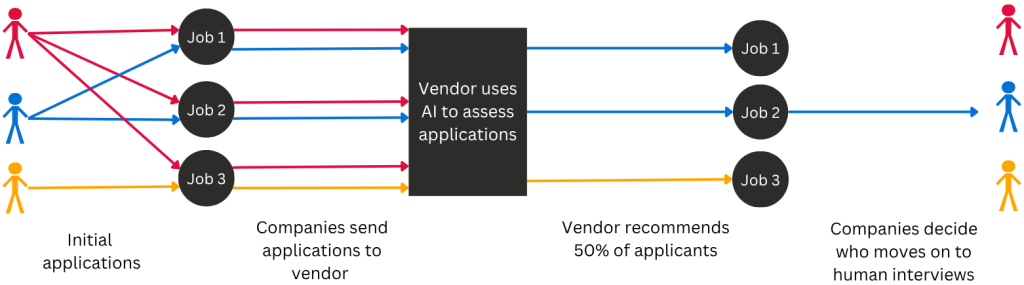
The article also shows that centralized hiring systems can generate systemic rejection, meaning applicants may be rejected across many roles rather than just one. This matters because repeated rejection across positions is not likely to be random noise; it may reflect a shared model or vendor pattern affecting multiple employers at once.[2]
Figure 1. Job applications are assessed by hiring AI to be recommended or not recommended. If an applicant is not recommended by the algorithm, they are likely to be rejected without further consideration by a human.
The practical concern is not only fairness for individual applicants, but also the broader structure of the hiring market. If many employers depend on the same tools, then a failure or bias in one system can be replicated at scale across organizations.[3,7, 5]
The article also points out a research and accountability problem. Because employers and vendors often restrict data access, independent researchers have limited ability to evaluate whether these systems are producing discrimination or homogenous outcomes.[4]
The authors recommend evaluating adverse impact at the level of individual job openings rather than relying only on overall averages. They also call for stronger market surveillance, monitoring of shared vendor dependence, and better access for independent researchers.[1]
The central message is straightforward: hiring algorithms are not automatically fair just because they are automated. When many employers use the same vendor, bias can spread quietly and consistently, making careful auditing and greater transparency essential.[5, 8]
The Result
The alternative to relying solely on automated hiring tools is to bring in TSP that will keep the human element at the center of the process. Algorithms can help organize data, but they cannot fully assess nuance, leadership style, cultural fit, or the subtle signals that often determine long-term success in a critical hire. A skilled search partner at TSP can evaluate candidates in context, ask the right questions, and identify the person who will not only meet the requirements on paper but truly thrive in the role. That human judgment is what makes executive search so valuable—and why the best firms are best positioned to help companies find the best person for the job.